
Catonsville Resident Lookup Records
Catonsville sits in Baltimore County as an unincorporated community. No city clerk or municipal court holds its records. Everything runs through county and Maryland state systems. Pick the record that fits your actual question. Deeds and property rolls tie a party to a parcel. Voter rolls and court indexes offer narrower, more exact matches. Estate files, old city directory volumes, church books, cemetery lists, and vital records each carry their own limits. Label every result by what it actually proves. Stretching an old entry into a claim of current residence is how lookups go wrong.
| Record | What it can confirm | Where | Access |
|---|---|---|---|
| Maryland Voter Lookup | A matching registration result, district, polling, ballot, and status information | Maryland State Board of Elections | Free, name, date of birth, and ZIP input required |
| CaseSearch | Public Maryland case-party, docket, and event information | Maryland Judiciary | Free index; files and certified copies are separate |
| EstateSearch | Estate number, decedent, personal representative, attorney, status, and docket trail | Register of Wills | Free index; office file route for more material |
| SDAT and county GIS | Parcel owner or mailing fields and an address or deed-reference path | State assessment and county GIS | Address, PAN, or map route; not a full occupant roll |
| MdLandRec | Recorded grantor, grantee, instrument date, and legal-description trail | Maryland Judiciary and State Archives | Account and image workflow; clerk or MSA copies |
| Vital records | Qualifying verification or certified record under record-specific rules | Maryland Division of Vital Records and historical custodians | Entitlement, identity, and current form requirements |
| Directory and yearbook material | Dated published address, school-year presence, or notice | BCPL, MSA, LOC, and local repositories | Library and archive access varies |
Hunting a former classmate or settling an old family question? Dated library sources often beat a web form. The Catonsville Branch History Room keeps yearbooks and local-history material. A yearbook or directory entry proves a published tie on one date. It does not show where that person lives now. For anything current, go to the responsible portal and search narrow.
CaseSearch for Catonsville Resident Lookup
Maryland Judiciary CaseSearch covers Baltimore County District and Circuit Court dockets plus other Maryland courts. Treat it as a docket index, not a biography or a Catonsville address list. Catonsville fields no municipal court of its own. Filter by county, court system, case type, party role, and filing dates. That way a name result means something. Federal matters run through the separate District of Maryland and PACER route.
| Last, first, middle | Participant or person name fields; exact last-name matching is available. |
|---|---|
| Party type | Limits the name to the listed role in a case. |
| Case type | All, civil, criminal, traffic, or civil citation choices were inspected. |
| Court system and county | Choose Circuit, District, or both, then narrow to Baltimore County. |
| Filing date | Use a From/To range or an exact date when a common name returns too much. |
| Case number | Separate mode with court and case-number fields for a known matter. |
CaseSearch defaults to an exact name search. For a partial surname, the Judiciary instructions call for at least the first character plus %. The first name can stay blank. Try initials, maiden and married forms, and spelling variants. A broad hit list still is not an identity claim. The 500-result cap also means you should add county, court, type, and date filters. Do not read the cap as a complete count.
| Result list | Case number, style or defendant, file date, location, and party type. |
|---|---|
| Docket detail | Case information plus events such as type, date, time, judge, court location, room, and result. |
| Not returned normally | Sealed, juvenile, expunged, adoption or protected family material, and other confidential records. |
A CaseSearch hit proves one thing: a matching public case exists. It does not place the party in Catonsville at that time. Coverage has gaps. An omitted document may sit with the Baltimore County clerk, a public terminal, a written request, or an archive. Ask about copies, certification, and archived files. That beats calling a missing web result a no-record finding.
Catonsville Voter Lookup Inputs
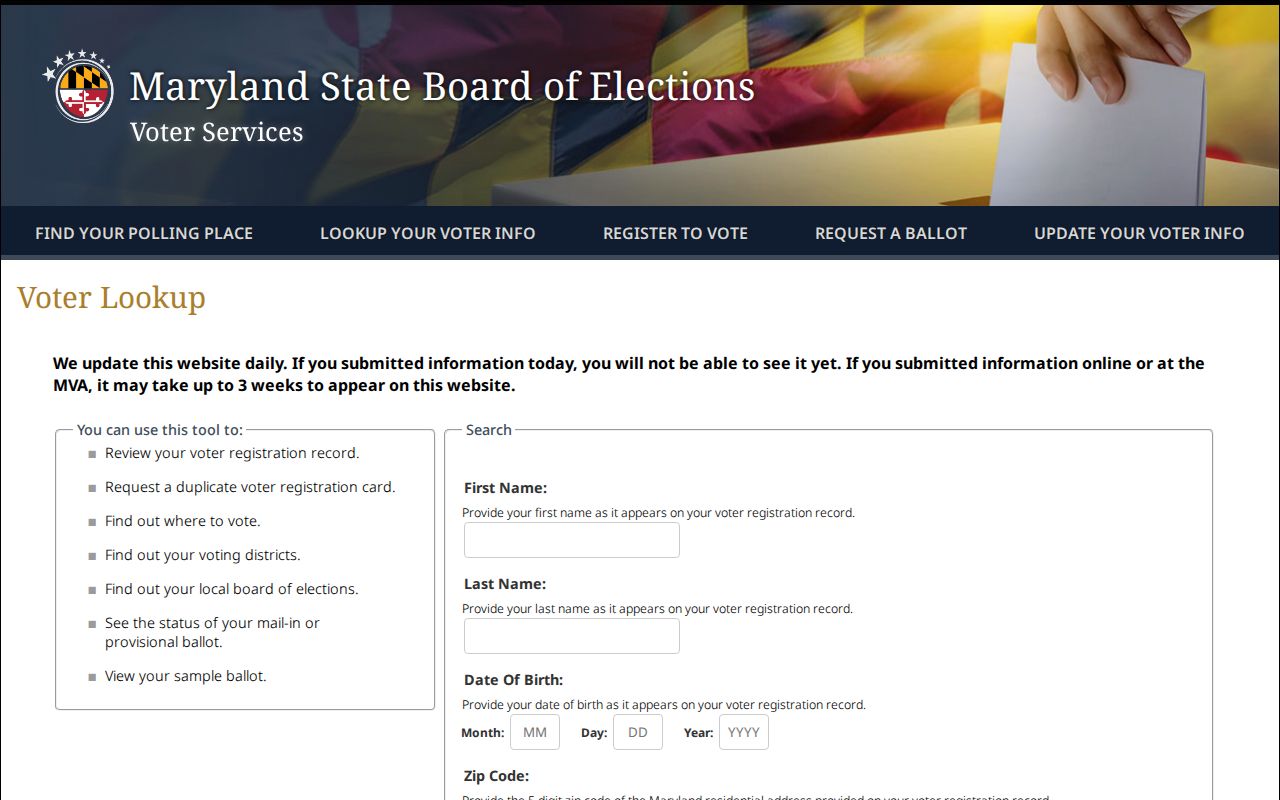
The official Maryland Voter Lookup targets one named person, not a street-wide list. The form asks for first name, last name, a date of birth in MM/DD/YYYY format, and a five-digit Maryland residential ZIP. Street number and middle initial are optional disambiguation tools. A match can display registration, polling place, district, ballot, and status details. It never reveals a full birth date, a ballot choice, or a private identifier.
The Maryland voter lookup form shows the name, date-of-birth, ZIP, street-number, and middle-initial controls. A Catonsville resident lookup relies on all of them.
Fill in the optional fields only when they match registration details you already trust. Keep the search date with the result.
Updates run daily. A recent mover may need the old ZIP. An online or MVA change can lag before it appears. The Baltimore County address and precinct tool explains district geography. Its own disclaimer notes it does not confirm registration. When the lookup returns a valid no-match, contact the local board rather than guessing at street searches.
Bulk voter data follows a separate path. Maryland Election Law §3-506 and its request form demand an application, a purpose, an oath, and a fee. They also set limits on use and redistribution. A walking list is no open substitute for the individual lookup. Protected voters and address-confidentiality participants never yield an actual address.
Note: The voter lookup can confirm one matching registration record, but it cannot produce a street-by-street list of Catonsville residents.
EstateSearch in a Catonsville Resident Lookup
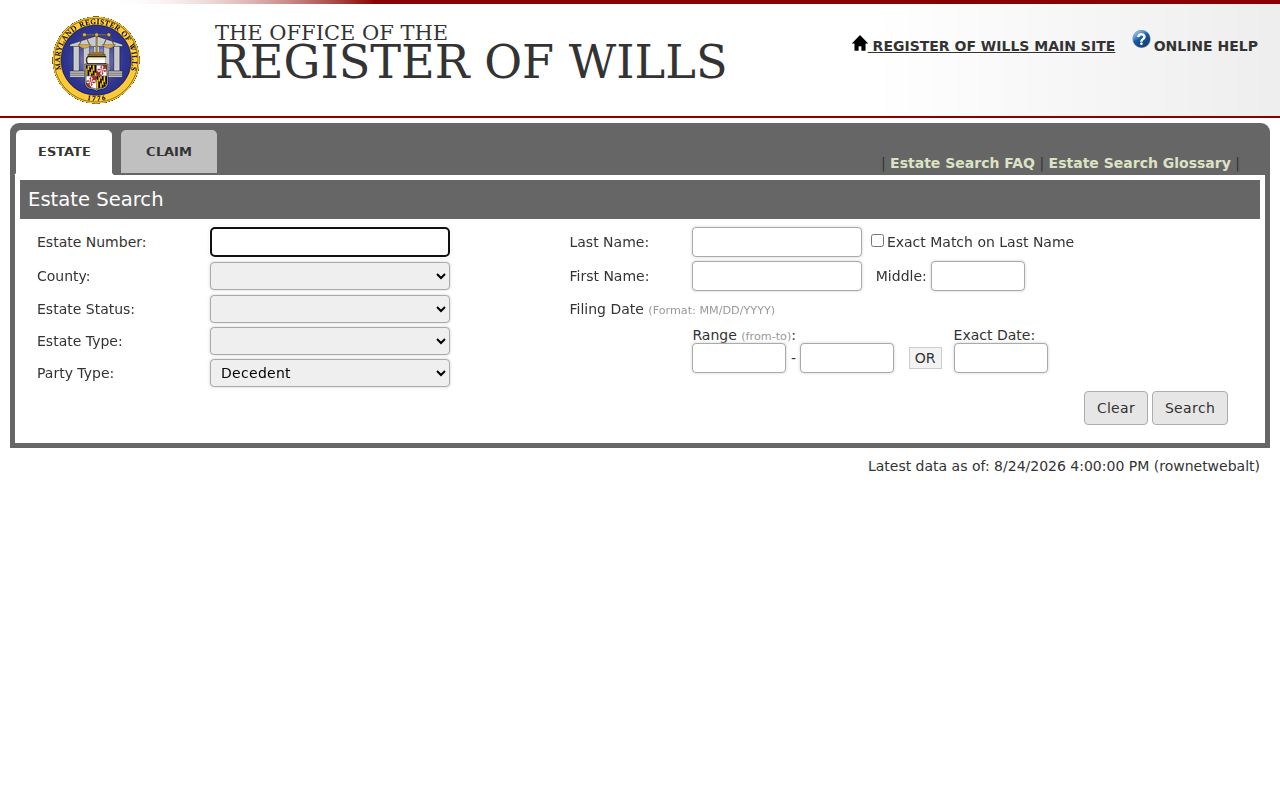
For probate or a family successor question, Maryland EstateSearch is the most direct official index. Search by estate number, last name with an exact option, county, first or middle name, status, filing date, estate type, or party. Party roles include decedent and personal representative. Updates land daily. Coverage spans every jurisdiction from 1998 forward with some older material. Results cap at 500. Treat a hit as a trail into probate administration. It is not a published address list of heirs.
EstateSearch supplies the status, type, county, date, and party controls a focused Catonsville resident lookup needs.
Before you ask the Register of Wills for a file, gather the essentials. Write down the estate number, the county, the status, and the exact name form. Those details speed up every copy request.
In EstateSearch, begin with the decedent's surname. Set the county to Baltimore when that fits. The docket and personal-representative fields then serve as extra records clues. They narrow the field to the right file. A later deed, an obituary, or a cemetery and church record can corroborate the trail you are building. Estate files may hold material whose access and reuse the office governs. So request only the relevant record and follow the Register of Wills procedure. Keep in mind that a name match alone proves nothing. It does not make a person an heir. And it does not establish a current address.
Vital Records for Catonsville Resident Lookup
Certified copies of Catonsville births and deaths sit with the Maryland Department of Health. Its Division of Vital Records holds them. Each record type carries its own access rule. COMAR 10.03.01.08 limits birth and death certificates to eligible requesters. That includes the person named on the record, a qualifying parent or guardian, an authorized representative, or a surviving spouse where allowed. It also includes someone with the required direct or tangible interest. Identification and the current VSA form govern the application. Asking for a certificate is not an open name search. The residents directory works differently.
The VSA birth-record page posts current eligibility rules and ordering channels. No single rule makes every Maryland birth or death record public. There is no fixed span of years. Genealogists chasing older material should look elsewhere. The Maryland State Archives, the issuing Circuit Court, church and cemetery collections, or another historical custodian may hold what a resident lookup needs. Confirm the record type and date first. Then order from the right office.
- Birth and death: VSA current forms and eligibility rules, with older research routed through MSA when appropriate.
- Marriage: VSA certified certificates generally cover 2007-present; earlier licenses route to the issuing Circuit Court or MSA.
- Divorce: VSA offers a qualifying verification route for current windows, while the Circuit Court holds the actual decree.
- Pre-registration clues: church registers, cemetery records, newspapers, probate, deeds, and county court books can fill historical gaps.
Salem Lutheran Church Records at MSA hold Catonsville material spanning 1848 through 1974. Baptisms, marriages, deaths or burials, and membership rolls all appear in the collection. Cemetery or interment notes appear there too. It is a historical route, though. It grants no shortcut around VSA rules for a current certificate.
Verify a Catonsville Resident Lookup
Match two or more independent identifiers before linking any records in a Catonsville resident lookup. Strong pairs combine a full name with a middle initial, an approximate age or birth date, an exact address, a spouse or relative, a court county and date, a dated directory entry, or an estate number. Normalize spelling variants before calling records conflicting. Catonsville often appears with a Baltimore mailing label. Older entries may spell it Catonville. Old street directories shorten street and personal names too. Each source proves only its own fact. A deed shows a recorded party to one instrument. A voter result shows a match under the form's inputs. A street directory shows a dated publication entry.
- Write the known name, date range, address, and any middle initial exactly as provided.
- Run the individual voter lookup only when the required date of birth and residential ZIP are known.
- Search CaseSearch with Baltimore County, court, case type, and date limits; compare party role and disposition.
- For a deceased person, search EstateSearch, then ask the Register of Wills about the identified file.
- Use a deed, directory, obituary, yearbook, church, cemetery, or vital-record route only for the question it can answer.
- Docket
- A court's running record of a case, including filings, events, and results, rather than a biography of the parties.
- Index and image
- An index points to a record through fields such as name, date, or number. An image is the document view and may have separate access rules.
- Certified copy
- A copy issued or authenticated by the keeper of the record for an official purpose. It is different from an online index entry.
Older name work usually lives on a different shelf. The Catonsville city directory collections supply dated address and telephone clues for past residents, while CaseSearch, VSA, EstateSearch, and the county offices stay the proper channels for their own records.
Catonsville Resident Lookup Request Path
A stalled search does not mean a dead end. Maryland's Public Information Act lets you request an existing non-exempt record in writing. The next move is not asking an agency to build a report. It is asking for a document that already exists. Describe it with reasonable specificity. Name the custodian first. Give the relevant name, date, address, county, record type, and preferred format. Request a no-match response when that would help you. The law does not obligate an agency to answer questions. It will not run research or create a database for you. It will not reveal exempt material, and it will not break a court or vital-record restriction.
The Maryland Attorney General's PIA FAQ lays out the request, timing, fee, exemption, and appeal framework. Custodians who cannot produce a record within 10 working days must respond with an estimate. They must give a reason and the applicable fees. The standard rule gives you the first two hours of search and collection at no charge. Additional search, review, preparation, or copy costs can still apply. Ask for electronic searchable delivery whenever the record is kept that way already.
A general PIA request is not always the best route. Court files and certified copies each sit with a particular office. So do archived material, estate records, vital records, and library holdings. The Baltimore County clerk, Register of Wills, and State Board of Elections all control different shelves. So do the VSA, Maryland State Archives, BCPL, and local historical custodians. A narrow request lets that office tell you plainly what exists and what is restricted.
Legal Limits for Catonsville Resident Lookup
Maryland law shields some residents from ordinary lookup. Safe at Home lets qualifying survivors use a substitute legal address with mail forwarding. So the real home address never surfaces in a routine record search. Protected-voter rules and court orders that withhold an address work the same way. A sealed docket, a restricted certificate, or a substitute address is a stop sign. It is not a puzzle. The right move is to ask the responsible records office what process it permits.
Maryland Safe at Home describes the address-confidentiality program and how to enroll. Wrong record? Note the URL and date. Name the field that is off, and hand correction evidence to the custodian who issued it. Court record errors go back to the originating court through CaseSearch. Voter problems belong to the elections board. Parcel disputes go to the assessment or GIS office.
Lawful use. Use Catonsville resident lookup results for a lawful, specific purpose and minimize what you repeat. Maryland law prohibits harassment, and protected addresses or restricted records must not be pursued or republished.
Note: A careful no-match can reflect a protected record, a spelling difference, an office-only file, or a source with limited coverage. Treat the gap as information in itself.